
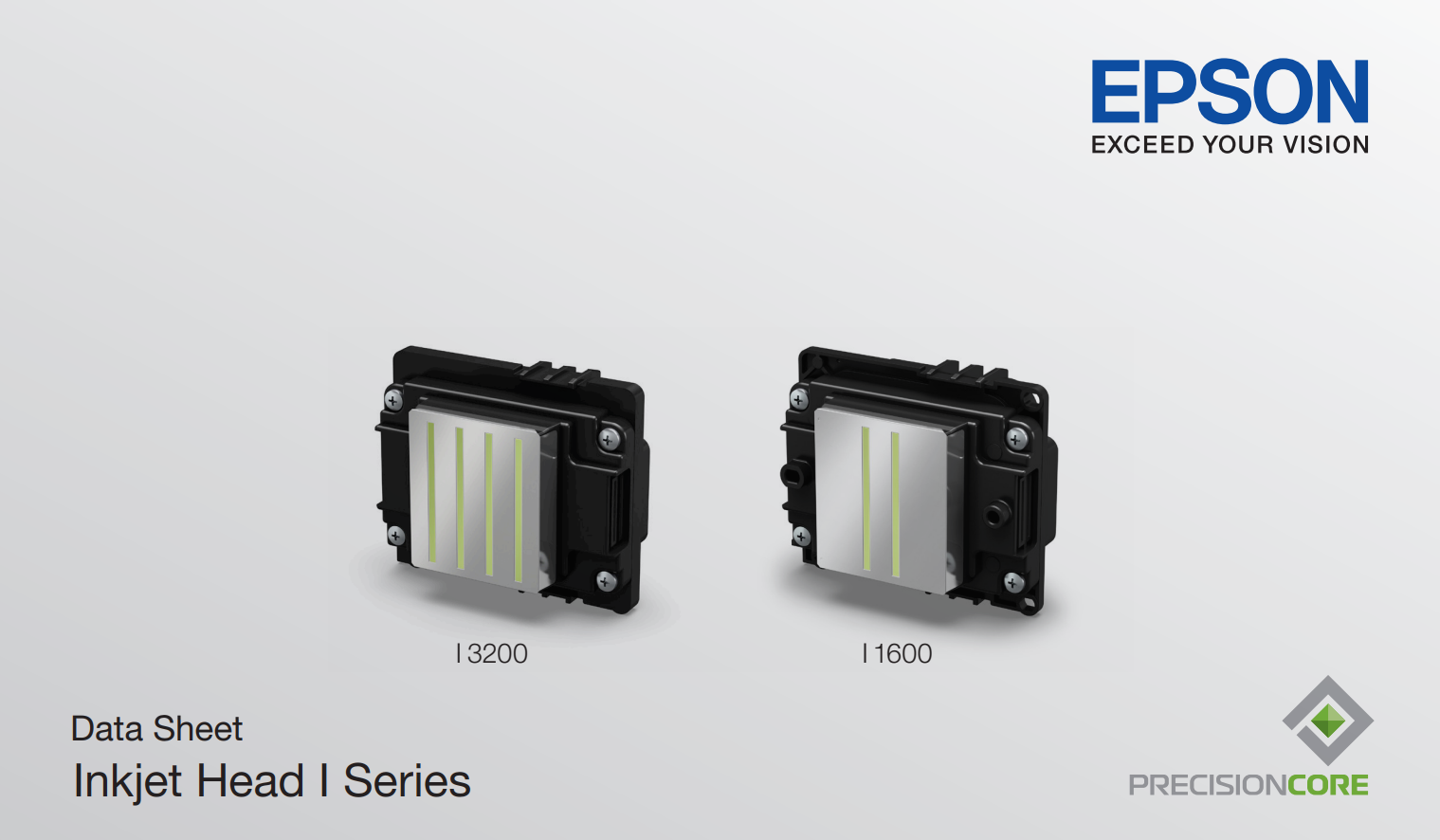
In DTF (Direct-to-Film), the printhead isn’t just a component—it’s the part that determines whether your shop runs smoothly or constantly feels “one clog away” from chaos. It controls edge sharpness, gradients, white ink laydown, production speed, and—maybe most importantly—how predictable your day-to-day operation is.
That’s why, in small-to-mid production DTF, the market has repeatedly gravitated toward Epson Micro Piezo printheads. Not because they’re magically perfect, but because they hit the best real-world balance of quality, ecosystem maturity, serviceability, and total cost of ownership.
1) What DTF Demands From a Printhead
DTF is a harsher environment than basic CMYK printing because the workflow typically relies on CMYK + heavy white ink (and sometimes spot/varnish layers). A DTF-capable head needs to handle:
- High ink density (white is the stress test) without banding or dropout
- Consistent jetting for fine text, halftones, gradients, and photo detail
- Stable production performance at usable speeds (not just “max spec”)
- Manageable maintenance (white ink settles; clogs aren’t theoretical)
- A mature service ecosystem: RIP support, parts availability, technician familiarity
In practice, DTF shops don’t win by chasing peak specs. They win by running repeatable output with minimal downtime.
2) Why Epson Printheads Are Widely Preferred for DTF
A) Print quality that translates well to garments
Epson’s Micro Piezo approach is known for:
- Crisp edges and small text
- Smooth gradients and clean halftones
- Strong detail on film that holds up after pressing
That last part matters: a print can look okay on film and still disappoint on fabric if white laydown and dot control aren’t stable.
B) Ecosystem advantage (the “boring” reason that matters most)
Epson-based DTF platforms have a huge global install base. That usually means:
- Easier sourcing for replacement parts
- More technicians who’ve actually seen your issue before
- More dialed-in RIP workflows, profiles, and community troubleshooting knowledge
Downtime is expensive in DTF. A mature support ecosystem is often worth more than a small speed advantage.
C) Proven CMYK + White behavior in DTF configurations
White ink is heavy, prone to settling, and unforgiving. Epson heads are used in many DTF platforms that have had years to refine:
- White ink circulation/agitation systems
- Waveform and jetting strategies (varies by OEM + RIP)
- Repeatable production presets that don’t require constant tinkering
So the “Epson advantage” often isn’t just the head—it’s the tuned platform around the head.
D) Predictable total cost of ownership (TCO)
Even if other printheads offer higher theoretical throughput, they often come with tradeoffs like:
- Higher upfront system cost
- More demanding environmental requirements
- More expensive spare heads/parts
- More specialized maintenance and calibration expectations
For many small/mid DTF shops, Epson-based systems hit the sweet spot: good output, manageable upkeep, and realistic ROI.
Important nuance: at truly industrial, very high-volume levels, other head families can be the better business decision. Epson dominates mainly because most DTF businesses aren’t operating at that scale.
3) DTF-Focused Printhead Comparison (Practical View)
| Epson Printhead | Typical Market Position | Common DTF Printer Type | Print Quality (Detail/Gradients) | Production Speed Potential | DTF Reliability (Long-Run Stability) | White Ink Handling (Difficulty) | Maintenance Workload | Best For |
|---|---|---|---|---|---|---|---|---|
| XP600 | Entry-level / budget | A3/13" desktop-style DTF | Medium–High | Medium | Medium (more dependent on daily care) | Medium–Hard | Medium–High | Startups, light-to-mid volume, cost-sensitive buyers |
| L1800 (6-color platform, commonly adapted) | Legacy entry-level (older generation) | A3/13" older DTF builds | Medium–High | Low–Medium | Medium (older platform; varies by supply/parts region) | Medium–Hard | Medium | Sampling, small batches, low speed requirement |
| i1600 | Newer entry-to-mid level | Compact / small-to-mid DTF | High | Medium–High | Medium–High | Medium | Medium | Growing shops wanting better consistency than entry heads |
| i3200 (i3200-A1 class, widely used in DTF) | Professional / mainstream production | 30cm / 60cm DTF (often multi-head) | High | High | High (mature DTF ecosystem) | Medium (easier with proper circulation) | Low–Medium | Most serious DTF businesses; best overall balance |
| 4720 / 5113 class (Epson Micro Piezo industrial family, where applicable) | Higher-end / industrial (depends on supplier) | Larger-format / higher output systems | High | High–Very High | High (when engineered well) | Medium | Medium | Higher volume lines that want speed and stability |
How to read this table:
- In DTF, white ink friendliness + serviceability often matter as much as speed.
- Epson wins on “practical success rate” because the surrounding ecosystem is mature and widely deployed.
4) The Real Reason: DTF Is a System, Not a Printhead
Printhead debates get oversimplified. In DTF, output quality and reliability come from the entire chain:
- Ink delivery + white circulation/agitation/filtering
- Capping station, wiper, pump quality (cleaning reliability)
- Humidity/temperature stability (consistent jetting)
- RIP profiles + linearization (color accuracy and smooth gradients)
- Operator habits (nozzle checks, scheduled cleaning, proper shutdown)
Epson tends to “win” because many manufacturers have optimized complete DTF systems around Epson heads—making it easier to get consistent results without needing industrial-level engineering and process control.
5) Which Epson Head Should a DTF Buyer Choose?
A simple way to think about it:
-
Entry level / budget: lower-cost Epson head families (varies by market)
Good for learning and low-volume production, but often more operator-dependent. -
Professional mid-volume (most shops): Epson i3200-class systems
Common choice for a strong balance of speed, detail, and stability. -
Higher volume: prioritize multi-head configurations and ink system robustness
In real production, multiple heads + stable ink supply often beats chasing a single “faster” head spec.
(Exact recommendations depend on width—A3/13", 30cm, 60cm—and your daily transfer volume.)
6) Buyer Checklist (Ask This Before You Commit)
Whether you buy Epson-based or not, ask the supplier:
- What’s the white ink management system (circulation/agitation/filtering)?
- What operating conditions are required (humidity/temperature)?
- What does maintenance look like daily/weekly (real time, not marketing)?
- What’s spare part lead time (head, dampers, cap tops, pumps)?
- Do you provide RIP profiles + training + support response times?
- What’s the real production speed at a quality setting customers will accept?
Conclusion
Epson printheads are often the first choice in DTF because they deliver a proven combination of sharp print quality, reliable CMYK+White behavior, strong global ecosystem support, and predictable total cost of ownership. Other industrial printheads can outperform Epson on peak speed, but they typically bring higher cost and complexity—making Epson-based DTF systems the most practical option for the majority of apparel transfer businesses.
If you tell me your target volume (transfers/day), preferred print width (A3 vs 60cm), and whether you plan to run 1 shift or multiple shifts, I can suggest which “class” of head/printer configuration usually fits best.